

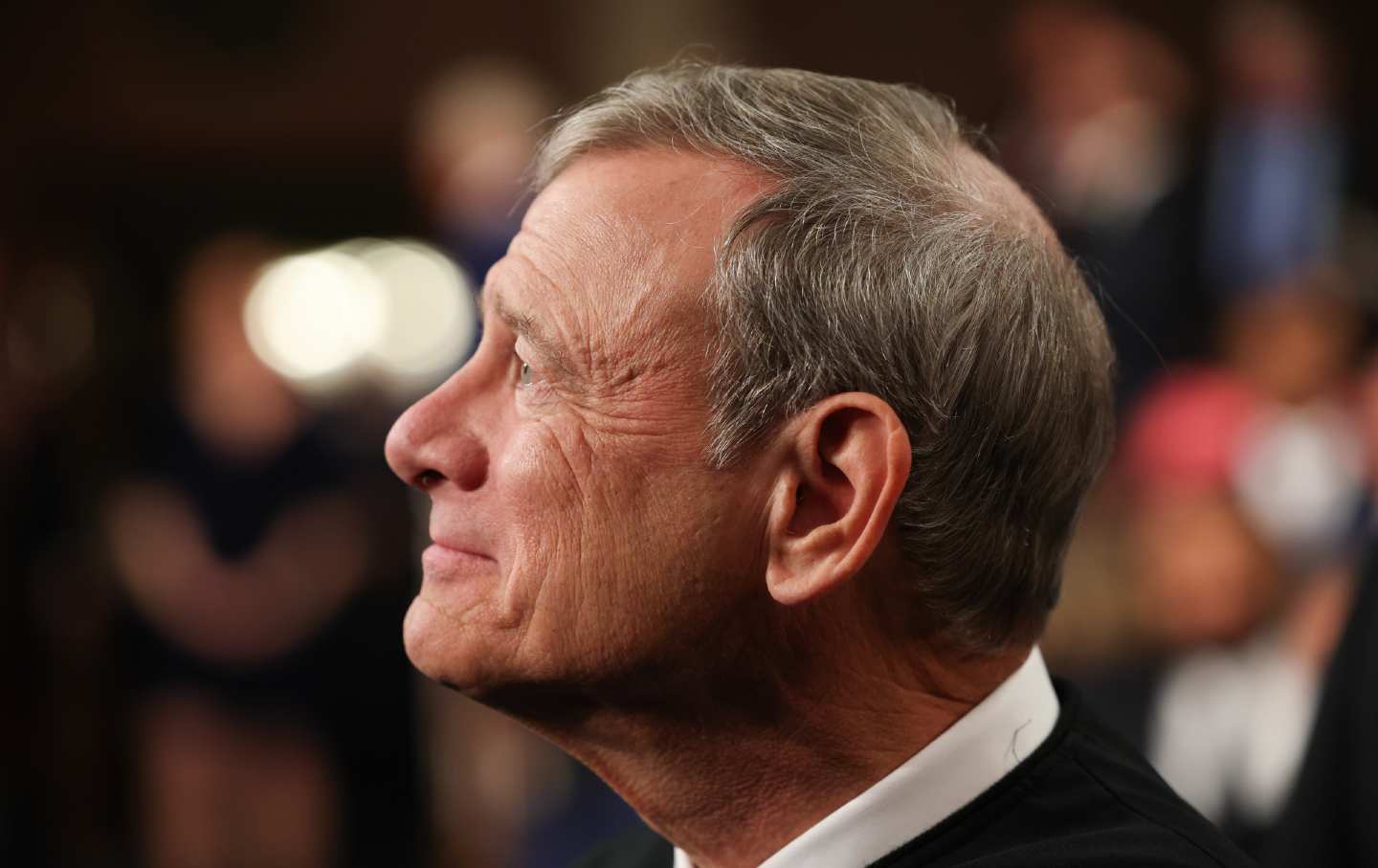
On Wednesday, the US Supreme Court essentially eviscerated the Voting Rights Act (VRA) in Callais v. Louisiana. The 6–3 party-line decision effectively ends any protection against racial gerrymandering and vote dilution, and opens the doors to redistricting across the South that will likely decimate Black and Latino representation in Congress, as well as state legislatures and municipal governments.
The central question in this case has a long history—and it begins with John Roberts’s very first days in Washington, DC, as a young aide in Ronald Reagan’s Department of Justice.
When Roberts first arrived at the DOJ in 1981, fresh off a clerkship for William Rehnquist at the Supreme Court, he was assigned two important portfolios: prepping Sandra Day O’Connor for her confirmation hearings before Congress, and drastically curbing voting rights.
O’Connor sailed through the Senate. The VRA would be more contentious: A 1980 Supreme Court decision in Mobile v. Alabama had required plaintiffs pursuing a Section 2 claim to prove that lawmakers had racial intent. That’s difficult to demonstrate, and brought nearly all Section 2 litigation to a halt.
Civil rights groups, Democrats, and moderate Republicans wanted to use the VRA reauthorization to clarify that Section 2 of the VRA prohibited election laws and procedures that had a racially discriminatory effect, not just those passed with clear racially discriminatory intent.
Congress intended to remedy all racially discriminatory effects. John Roberts had a different idea.
The Reagan administration was divided. Moderate Reaganites did not want to battle over something popular and historic. But ideological conservatives within the DOJ were spoiling for the fight. They were content to extend the act, just so long as it was impossible to use. Roberts led the way.
Roberts’s papers from this era, housed at the National Archives, show his determination and dedication. They include memos and talking points, draft op-eds, scripted answers for bosses to deliver in meetings and before Congress, and presentations for senators and Hill staff. His files show how Roberts devised the messaging strategies that made it possible for the administration to claim that it supported reauthorization, while actually helping neuter the VRA—a skill he would go on to master as chief justice.
Before Congress two decades later, however, Roberts obscured this role. When Roberts was asked in his confirmation hearings by Democratic Senator Russell Feingold of Wisconsin why he then “want[ed] to make Section 2 cases so difficult to prove,” he distorted the 1982 political debate, rewrote its history, and downplayed his own leadership. One could even make the case that he misled Congress under oath.
“Senator,” Roberts replied, “you keep referring to what I supported and what I wanted to do. I was a 26-year-old staff lawyer. It was my first job as a lawyer after my clerkships. I was not shaping administration policy. The administration policy was shaped by the attorney general on whose staff I served. It was the policy of President Reagan. It was to extend the Voting Rights Act without change for the longest period in history at that point, and it was my job to promote the attorney general’s view and the president’s view on that issue. And that’s what I was doing.”
But it was not the policy of President Reagan. It was not the president’s view. And as Roberts’s own papers would show, he was doing far more than that.
US Attorney General William French Smith might have been the figurehead. But as Michael Carvin, who worked alongside Roberts as part of a group of ideological warriors in the DOJ known as the “band of brothers,” told me: “Voting—that was John’s fight. Always John’s fight.… I do think our strong feelings about all this comes from the fact that we were dealing with these arguments in 1982 and 1983.”
Roberts started at the DOJ as a special assistant in the civil rights division on August 14, 1981. Voting rights became his focus. The DOJ was the hub of opposition to the effects test in section 2 of the VRA. Bruce Fein, a Roberts DOJ colleague, remembers Roberts as the architect. “He was intimately involved in that. Definitely, intimately involved,” he says. “John, more than anyone, was very familiar with the voting rights stuff.”
Roberts started from a difficult position. Before he arrived, the pragmatic White House aides who wanted to avoid the messiness of a voting rights fight appeared to hold the winning hand. A lopsided House vote embraced the effects test. And during the summer of 1981, Reagan moved toward that position. That August, the president told The Washington Star that he would back a 10-year reauthorization.
Roberts drove reconsideration of this policy at the highest level. That fall, when Reagan seemed convinced on the effects test, the DOJ pushed back, hard. After the White House released a November statement that Reagan would support whatever compromise Congress reached, Roberts and his boss, Attorney General Smith, fumed. Smith demanded a meeting with Reagan. Roberts armed him with talking points. Reagan embraced two of Smith’s proposals: maintaining the intent standard, and making it easier for Southern localities to escape preclearance–the provision under the VRA mandating that districts with a history of racial discrimination submit planned maps to the DOJ for certification.
Reagan now declared the effects standard “new and untested”—a position that hewed almost word for word to Roberts’s talking points. In his end-of-the-year news conference, Reagan channeled Roberts again. “The effect rule could lead to the type of thing in which effect could be judged if there was some disproportion in the number of officials who were elected at any governmental level,” Reagan said. “You could come down to where all of society had to have an actual quota system.”
This is almost exactly what Roberts wrote in his December 1981 memo, “Why Section 2 of the Voting Rights Act Should Remain Unchanged.” “Incorporations of an effects test in Section 2,” he argued, “would establish essentially a quota system for electoral politics.” Then he wrote the line that could be seen as defining decades of future jurisprudence: “Violations of Section 2 should not be made too easy to prove, since they provide a basis for the most intrusive interference imaginable by federal courts into state and local processes.”
Roberts orchestrated Reagan’s shift. He scripted the president’s statements. He placed the administration into an intent-vs.-effects fight that Reagan’s political counselors thought unnecessary.
The next battle would be before the US Senate. Roberts would script that too—as his memos and communications at the National Archives clearly show.
The Roberts files amount to hundreds of pages. They reveal the deep roots of his quarrels with the VRA as well as the outsize role he played in 1982, despite his disingenuous avowals before Feingold and other congressional Democrats in his 2005 confirmation hearings. They provide a portrait of a young ideologue who has spent decades hiding his ideology. And in the John Roberts who battled to immobilize the VRA in 1982 can be heard an eerie echo of the chief justice who would have the final word.
When Roberts opened his newspaper on November 16, 1981, he discovered a column by Vernon Jordan, head of the National Urban League, titled “Diluting Voting Rights.” Roberts could not have liked what he read. Jordan opened his argument sounding much like pragmatic Reagan aides. Reagan’s endorsement of the intent standard “was not only a political mistake,” Jordan wrote, but a “disservice” to conservatism.
Then the civil rights leader lowered the boom. Intent to discriminate, he wrote, is impossible to prove. “Local officials don’t wallpaper their offices with memos about how to restrict minority-group members’ access to the polling booth,” Jordan wrote. “Discriminatory effects are clear to all.” Proving intent, he argued, shifted and required the burden of proof and required evidence that “would be virtually impossible to assemble.”
“The President’s endorsement of the Voting Rights Act,” he concluded, “is a sham.”
Jordan’s op-ed sent the Department of Justice into a tizzy. The following morning, Roberts drafted a response and circulated it to DOJ higher-ups. His pugnacious response insisted that the intent test would make a “radical change” to the Voting Rights Act and slammed the congressional version that included the effects test as an “untested piece of legislation” and a “radical experiment.” Roberts conceded that local officials might not wallpaper racist memos in their offices, but insisted that “circumstantial evidence” would still suffice, “as Mr. Jordan presumably knows.” Roberts reached for an old saw in his conclusion: “As the old saying goes, if it isn’t broken, don’t fix it.”
It’s hard to believe that this argument even convinced its author. As Roberts presumably knew, in blithely asserting that intent was readily provable, he ignored how the lawyers seeking to preserve the VRA’s standards in a key test case in Mobile, Alabama, had presented decades of historical evidence, circumstantial evidence, and firsthand testimonials of widespread and devastating racist rigging of the city’s civic and political life, all of which lower federal courts found convincing. The Supreme Court, and Roberts’ anti–voting rights mentor William Rehnquist, brushed it all aside.
“The only ones who could be disappointed by the President’s actions,” Roberts held, “are not those truly concerned about the right to vote but rather those who, for whatever reason, were simply spoiling for a fight.” Thus did a 26-year-old Justice official who launched his career in conditions of segregated privilege dismiss Jordan’s long-established integrity as an advocate for racial justice.
Roberts would pen almost two dozen additional memos urging the DOJ to stand firm behind Mobile’s intent standard. Meanwhile, while the future chief justice simmered, his legislative foes were quietly reconstituting a majority in the US Senate.
Decades later, when Roberts used his influence as chief justice to unravel much of Section 2 and freeze Section 5 of the Voting Rights Act, he only needed to command a majority of five. The Senate had a higher magic number: 60, the amount necessary to stave off a filibuster to block the VRA’s reauthorization in 1982.
Strom Thurmond chaired the Senate Judiciary Committee. Opponents of the VRA’s effects provision felt confident that they could engineer a host of obstructionist feints and amendments to block its passage. So it meant something when Senators Ted Kennedy and Charles Mathias, the bipartisan cosponsors of reauthorization in the Senate, filed their bill—including the effects test—with 61 cosponsors. If the coalition of 40 Democrats and 21 Republicans held, not only would the reauthorization pass easily; it would also overcome any filibuster. Thurmond, the old South Carolina segregationist, sputtered in disbelief when informed that 61 senators introduced the reauthorization together. “They must not have read the bill!”
An equally stunned Roberts prepared to fight on. “Do not be fooled by the House vote or the 61 Senate sponsors of the House bill into believing that the President cannot win on this issue,” Roberts wrote in a January 1982 memo to the attorney general. Roberts’s allies were segregationists, his math was bad, and his political instincts worse—but he urged his troops onward, confident in his own assessment of Congress. “Many members of the House did not know they were doing more than simply extending the Act, and several of the 61 Senators have already indicated that they only intended to support simple extension,” he wrote. “Once the senators are educated on the differences between the President’s position and the House bill, and the serious dangers in the House bill,” Roberts insisted, “solid support will emerge for the President’s position.”
That education was to begin with the Senate Judiciary Committee, The day before it began holding hearings, the administration abruptly asked to delay the attorney general’s testimony. Roberts remained focused. On January 21, 1982, he sent Smith six pages of draft questions and answers to help guide his remarks. In his behind-the-scenes brief to his boss, it’s clear that there was simply no improvement to the VRA that Roberts was willing to countenance.
When he detailed his objections to the effects test, Roberts supplied a tendentious account of supposed open-minded inquiry that pointedly ignored the testimony of experts and misrepresented the words of civil rights leaders. He counseled Smith to tell Congress, “In reviewing the Voting Rights Act last summer in the course of preparing recommendations to the President, I met personally with scores of civil rights leaders.” Roberts wrote, “The one theme from these discussions was clear: the Act has been the most successful civil rights legislation ever enacted and it should be extended unchanged. As the old saying goes, if it isn’t broken, don’t fix it.” Here Roberts was merely parroting an earlier talking point he’d circulated during the House debate; it had nothing to do with the actual views of civil rights leaders who, in fact, were determined at all costs to repair the defective 1980 Mobile decision.
His memos encouraged Smith to double down on loose talk of racial quotas before Thurmond’s committee, contending without any empirical backing that the effects test “would establish a quota system for electoral politics”—here he underlined “quota system”—which “we believe is fundamentally inconsistent with democratic principles.”
Five days later, on January 26, Roberts again urged Smith to stiffen his resolve on the effects question as the attorney general prepared to begin his testimony the next day. The same day, Roberts also attended a crucial meeting at the White House where DOJ officials sought to shore up Reagan’s opposition to the effects test—“once and for all,” a seemingly frustrated Roberts wrote.
Popular
“swipe left below to view more authors”Swipe →
In this final prehearing memo, the young aide exhorted his boss as follows: “I recommend taking a very positive and aggressive stance.” Roberts followed the same counsel in the White House meeting; he had clearly grown weary of all the bureaucratic skirmishing with Reagan’s political team, and demanded that the White House “actively work” to enact the DOJ’s policy. He insisted that his position could be sold politically. “The President’s opinion is a very positive one,” Roberts wrote, repeating his pet mantra. “If it isn’t broken, don’t fix it.”
In the meeting and his memos, Roberts maintained that the effects test would “throw into litigation existing electoral systems at every level of government nationwide when there is no evidence of voting abuses nationwide supporting the need for such a change.” Roberts also again sought to tie opposition to the effects test to the administration’s overall stance on race and affirmative action. “Just as we oppose quotas in employment and education, so too we oppose them in elections.” “It is very important that the fight be won, and the President is fully committed to this effort,” Roberts concluded, imperiously. “His staff should be as well.”
No one could question Roberts’s commitment. That day he sent Smith yet another memo, a two-page response to an editorial in The Washington Post that endorsed the effects test. Then, in an early February 1982 memo to his immediate DOJ boss, Brad Reynolds, Roberts offered extensive handwritten edits on a draft op-ed that he thought needed to strike a more aggressive tone. “I do not agree with the Attorney General that it is necessary to ‘talk down’ to the audience,” Roberts proclaimed. “The frequent writings in this area by our adversaries have gone unanswered for too long.”
Roberts remained hopeful that his position would prevail in the Senate, either by putting the filibuster back in play, enabling a presidential veto, or slowing things down and hoping to gain a negotiating cudgel as the VRA neared expiration. Whatever obstructionist vision beguiled him most, Roberts worked the Senate hard. He assembled clip packages of anti–results test op-eds. He sent friendly offices his “Why Section Two of the Voting Rights Should Be Retained Unchanged” essay. He ran this offensive by Ken Starr, then a counselor to the attorney general before investigating President Clinton as the nation’s leading sex cop (alongside future justice Brett Kavanaugh), with a handwritten note on the attorney general’s letterhead: “Ken, possibilities to distribute to senators. John.”
Recalcitrant senators hit the brakes. Republican Senator Orrin Hatch of Utah, who chaired the Judiciary Committee’s subcommittee on the Constitution, reversed course after six weeks of hearings focused almost entirely on intent versus effects—and restored the original language on intent. The bill then moved to Thurmond’s kingdom, the Judiciary Committee. By then, Kansas GOP Senator Bob Dole had seen enough. Dole was determined that the GOP be the party of Lincoln, not Thurmond. He quietly forged a compromise. Section 2 would carry a results standard. The language of the accompanying Senate report could not have been clearer. Racial effects would be enough. Dole informed Reagan that the DOJ could continue the fight—but it was fated to lose. He had 80 votes.
Back at Justice, Roberts’s band of brothers didn’t seethe so much as they threw up their hands in resignation. “The Reagan administration took the principled view over the politically advantageous,” says Michael Carvin, who worked alongside Roberts at the DOJ and would become a prominent conservative Supreme Court litigator, “and then they eventually caved.”
The lesson was simple: If you want to change the law, change the judges. When Roberts and and his fellow George W. Bush appointee Samuel Alito arrived at the Supreme Court, the same arguments would carry the day—not because things had actually changed in the South, but because the theater of battle had now shifted to the judiciary. You didn’t need 60 senators or 218 representatives. Five like-minded conservatives would be enough—and now they would have six.
Feingold, who posed the question that Roberts answered in such a misleading manner, now looks back in disbelief. “I don’t think any of us felt that he was really going to try and undermine the Voting Rights Act,” he told me, “which is of course one of the worst things he could have possibly done. Then he did.”
John Roberts lost in 1982. He never stopped trying to turn back the clock. On Wednesday he succeeded. You might say that was the plan all along.
From illegal war on Iran to an inhumane fuel blockade of Cuba, from AI weapons to crypto corruption, this is a time of staggering chaos, cruelty, and violence.
Unlike other publications that parrot the views of authoritarians, billionaires, and corporations, The Nation publishes stories that hold the powerful to account and center the communities too often denied a voice in the national media—stories like the one you’ve just read.
Each day, our journalism cuts through lies and distortions, contextualizes the developments reshaping politics around the globe, and advances progressive ideas that oxygenate our movements and instigate change in the halls of power.
This independent journalism is only possible with the support of our readers. If you want to see more urgent coverage like this, please donate to The Nation today.
More from The Nation

The comedian’s mega-viral send-up of conservative women is more important than you might think.

The AAP has shown sustained moral failure when it comes to confronting the genocide—as I know firsthand.

Mukbang videos have become a lifeline for university-age women, whose content pays college fees, supports their families, and supplants traditional career paths.
And RFK Jr.’s HHS leadership will only make contracting arcane illnesses like this one a more common affair.
The pattern is always the same: The public demands change, but the Democrats cave to political pressure and maintain the status quo, allowing the machinery to grow.

The tech company’s CEO Alex Karp delivers a self-serving broadside that’s steeped in oligarchic hubris and authoritarian nihilism
